June 15, 2026 • Sanjay Gupta • 9 min reading time • Prices verified June 24, 2026
DJI Mini 4K vs. Mini 3: The Upgrade Math for Pilots Who Already Own a Budget Drone
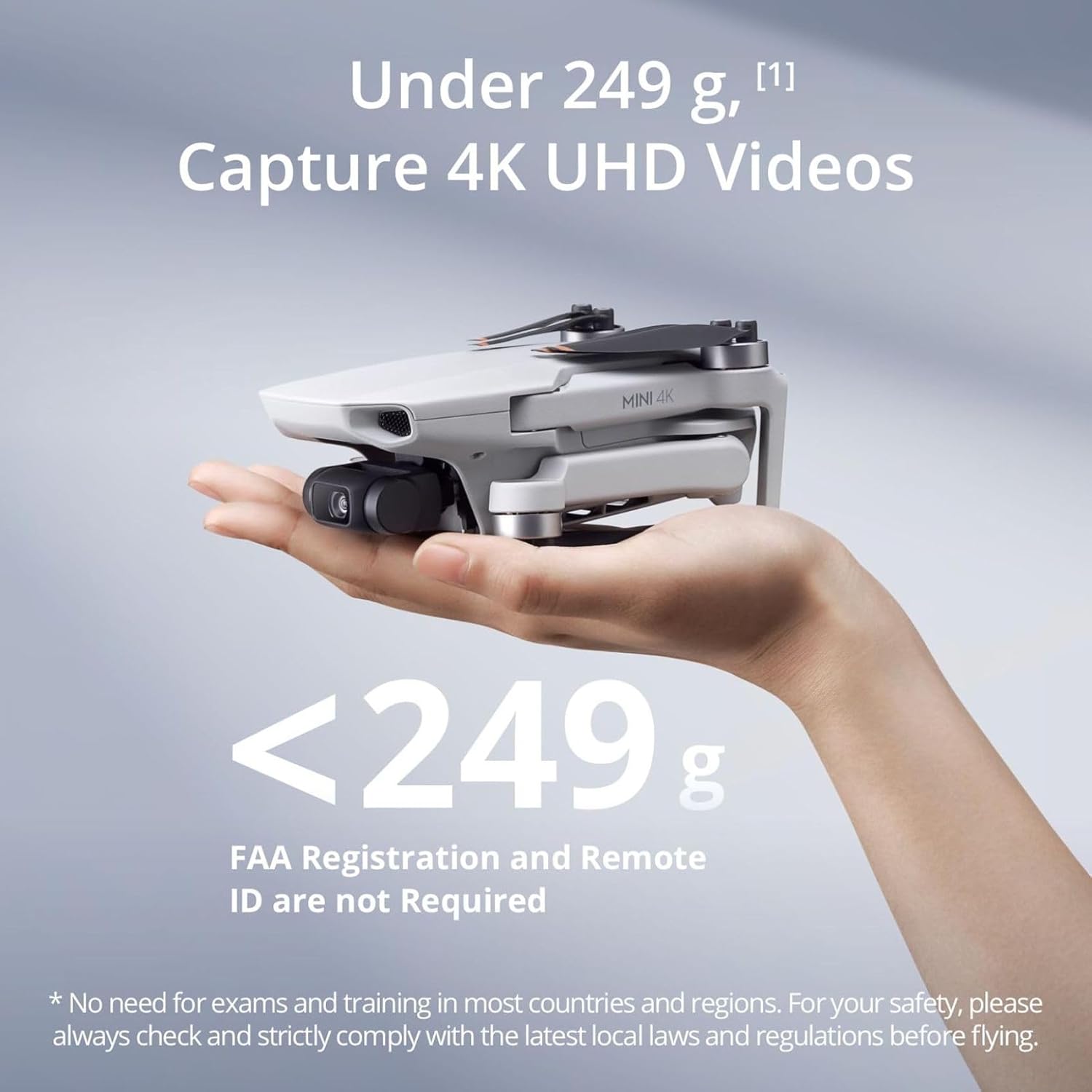
If you’ve recently gotten serious about aerial photography or video — that’s shooting footage from a small flying camera — you’ve probably heard the terms Mini 3 and Mini 4K thrown around. Both are compact consumer drones from DJI, the dominant brand in the category, and both weigh under 249 grams (about half a pound), which matters because drones below that threshold avoid the most burdensome registration and airspace rules in the U.S., EU, and many other markets. The Mini 3 launched in mid-2023 as DJI’s entry-level option. The Mini 4K arrived roughly a year later as a slight step up — same weight class, different internals and price. If you already own a Mini 3 and the Mini 4K is sitting in your cart, this article is the math you need before you pull the trigger. We’ll break down what actually changed, what didn’t, and the conditions under which the upgrade earns its cost.
What You’re Actually Comparing: The Spec Gap
Let’s start with the honest summary. The Mini 3 and Mini 4K are not dramatically different drones. They share the same sub-249g form factor, similar three-axis mechanical stabilization (a gimbal — a motorized mount that keeps the camera level regardless of wind or movement), and the same regulatory footprint. The differences are real but specific.
By the numbers:
| Spec | DJI Mini 3 | DJI Mini 4K |
|---|---|---|
| Video resolution | 4K/30fps, 2.7K/30fps | 4K/60fps, 4K/30fps |
| Sensor size | 1/1.3-inch CMOS | 1/1.3-inch CMOS |
| Max bitrate | 150 Mbps | 150 Mbps |
| Obstacle sensing | Forward + downward only | Forward, backward, downward |
| Transmission system | O2 (approx. 10 km range) | O4 (approx. 20 km range) |
| MSRP (drone only, 2025–2026) | ~$229–$249 | ~$299 |
Sources: DJI Mini 4K official product specifications, DJI.com; DJI Mini 3 official product specifications, DJI.com.
The sensor is identical, which means image quality in good light is nearly indistinguishable between the two. That’s not a knock — the 1/1.3-inch sensor is genuinely capable. What you’re paying the upgrade premium for is: 4K at 60 frames per second, backward obstacle sensing, and the jump from the O2 to O4 video transmission system.
Each of those matters differently depending on how you fly. Let’s break them down.
The Three Real Upgrades — and How Much Each One Is Worth
1. 4K/60fps: The Slow-Motion Argument
The Mini 3 tops out at 4K/30fps. The Mini 4K shoots 4K at 60fps, which means you can slow footage to half speed in post-production while staying in the 4K resolution tier — no cropping to 1080p to get smooth slow-motion, as you’d have to do with the Mini 3.
For content creators cutting Instagram Reels, YouTube shorts, or client real estate walkthroughs, this matters more than the spec sheet makes it look. TechRadar’s 2024 review of the DJI Mini 4K identified the 60fps mode as the clearest differentiator for video-focused pilots, particularly when capturing fast-moving subjects like athletes, vehicles, or wave action where 30fps can look slightly choppy when slowed in the edit.
The tradeoff: 4K/60fps chews through storage faster — plan on 64GB minimum per session — and generates more heat in sustained flights. Operators flying extended summer sessions report minor thermal throttling, though this is a physics constraint across the sub-249g drone category rather than a flaw specific to DJI.
Verdict on this upgrade: If slow-motion 4K is in your delivery workflow right now, or you know a client will request it in the next six months, this alone justifies the price gap between the two drones. If you’re shooting static real estate or casual travel content at 24fps, it doesn’t move the needle.
DJI
$269.00
In stock on Amazon
Check price on Amazon2. Backward Obstacle Sensing: The Insurance Premium
The Mini 3 has obstacle sensors on the front and bottom. The Mini 4K adds rear-facing sensors. This sounds incremental — and in open airspace it genuinely is. But obstacle sensing is drone insurance, not a luxury feature. The question is whether the scenarios where rear sensing saves you are common in your flight profile.
Rear sensing matters most in two situations: flying in APAS (Advanced Pilot Assistance System) mode, where the drone automatically navigates around objects; and pulling back in cinematic or orbit shots near structures, trees, or hillsides. Pilots who fly pre-programmed cinematic moves in tight environments — urban facades, forest canopy work, architectural clients — will find the backward sensor earns its keep quickly. Pilots who fly in open fields or coastal areas largely won’t notice its absence.
DPReview’s 2024 DJI Mini series comparison notes that obstacle avoidance across the budget DJI tier remains directional and reactive rather than truly intelligent — it functions as a collision buffer, not a full 360-degree navigation system the way the Mini 4 Pro delivers. Manage expectations accordingly: the rear sensor reduces risk in common pull-back scenarios, but it is not omnidirectional protection.
Verdict on this upgrade: High value for tight-environment and architectural pilots. Low value for open-sky shooting.
DJI
$269.00
In stock on Amazon
Check price on Amazon3. O4 Transmission: Range That Mostly Doesn’t Matter (But Sometimes Does a Lot)
The jump from O2 to O4 doubles the theoretical range from roughly 10 km to 20 km. In practice, you will never legally fly 20 km from yourself — visual line-of-sight rules cap real-world operating distance far below both figures in most jurisdictions. So why does O4 matter?
Signal quality at legal operating distances. O4 is a newer protocol that handles interference and compression artifacts better in urban RF-dense environments where competing Wi-Fi and Bluetooth signals can degrade video feeds. The Verge’s 2024 overview of the DJI Mini 4K specifically identified the O4 transmission system as the most practically meaningful single improvement for pilots who fly near buildings, calling out fewer signal dropouts and a more stable live feed even at distances well under 500 meters.
If you fly primarily in rural or suburban open space with clean RF environments, O2 is adequate and you won’t notice the difference in day-to-day flying. If you’re operating in dense urban areas or at events with heavy wireless traffic, O4 is a consistent quality-of-life improvement that shows up in the feed rather than on a spec sheet.
Verdict on this upgrade: Urban and event pilots will notice a real difference. Rural and suburban open-sky pilots will not.
DJI
$139.00
In stock on Amazon
Check price on AmazonWhat Hasn’t Changed (And Should Temper Your Expectations)
This is the part that upgrade comparisons often skip: the things that are identical between the two drones and will remain friction points regardless of which unit you fly.
Sensor and image quality in low light: Both drones use the 1/1.3-inch CMOS sensor. In good light, footage from the two models is essentially indistinguishable. Low-light performance — where a physically larger sensor would genuinely help — is the same story on both. If you’ve been frustrated by grainy Mini 3 footage at dusk or in overcast conditions, the Mini 4K will not fix that.
Battery life: Both are rated for approximately 38 minutes of flight time under manufacturer test conditions. CNET’s 2025 best budget drones buying guide notes that real-world flight times across the DJI Mini tier consistently run 15–20% below rated specs in field conditions, landing closer to 28–32 minutes in moderate wind — consistent with the rest of DJI’s sub-249g lineup. This is not a complaint specific to either model; it’s the cost of flying a camera in a chassis that weighs less than a can of soup.
No ActiveTrack, no Hyperlapse, no D-Log M: Neither the Mini 3 nor the Mini 4K includes ActiveTrack (autonomous subject tracking), Hyperlapse shooting modes, or D-Log M color profile (a flat color grade that gives videographers significantly more flexibility when color grading in post-production). You would need the Mini 4 Pro to access those features. If subject tracking or a professional color workflow is on your requirements list, neither drone solves it.
Controller compatibility: The Mini 4K uses the same RC-N1 controller as the Mini 3 in the standard kit. Your existing controller transfers if you’re upgrading, which eliminates one meaningful hidden cost. Accessories are a different story: ND filters (neutral density filters — tinted glass that reduces light entering the lens for more cinematic motion blur) from the Mini 3 are not cross-compatible with the Mini 4K due to slight differences in lens geometry. Budget approximately $30–$60 for a new ND filter set if you rely on them regularly.
The Upgrade Math: A Clear Decision Frame
Here’s the honest cost-benefit summary for a Mini 3 owner considering the Mini 4K in mid-2026 market conditions.
The upgrade costs roughly $50–$70 net if you sell your Mini 3 in good condition. Used Mini 3 units with the original controller regularly clear $160–$180 on the secondary market. The Mini 4K drone-only runs approximately $299. You are not spending $299 — you are spending the delta between what you recover and what you pay.
That $50–$70 buys you:
- 4K/60fps video capability
- Backward obstacle sensing
- O4 transmission stability
The decision rules:
-
If you’re delivering client video work that will ever require slow-motion 4K — upgrade. The 4K/60fps capability alone justifies the net cost at one or two deliverables.
-
If you fly cinematic or architectural shots near structures — upgrade. The rear obstacle sensing will prevent a crash you haven’t had yet, and one prevented crash is worth multiples of the cost delta.
-
If you operate in dense urban environments with RF interference — upgrade. The O4 stability improvement is reported consistently enough across independent reviews from The Verge and TechRadar to trust at face value.
-
If you fly open rural or coastal spaces, shoot primarily at 24–30fps, and don’t have clients requesting slow-motion — don’t upgrade. Your Mini 3’s sensor, battery, and regulatory footprint are identical to what you would get. Keep the $299 toward a second battery set, an ND filter kit, or a storage upgrade.
-
If your real frustrations with the Mini 3 are low-light noise, absent subject tracking, or a flat color profile for grading — neither drone solves those. Save toward the Mini 4 Pro (approximately $759), which includes D-Log M, ActiveTrack 360, omnidirectional obstacle sensing, and a meaningfully different feature tier. Per DPReview’s 2024 Mini series comparison, the jump from the budget to mid-tier DJI lineup is steeper in price but genuinely transformative in capability — in a way that the Mini 3-to-Mini 4K step simply is not.
DJI
$293.55
In stock on Amazon
Check price on AmazonThe Mini 4K is a tighter, better-specified drone than the Mini 3. It is not a new generation — it is a firmware and silicon refresh with three targeted improvements. Whether it earns the upgrade cost depends entirely on whether those three specific improvements map onto your current shooting scenarios. If they do, the net math is straightforward. If they don’t, patience pays more than pixels.